ArmInfo. Russia will attempt to establish a pragmatic dialogue with any Armenian leadership that will be formed following the June parliamentary elections.
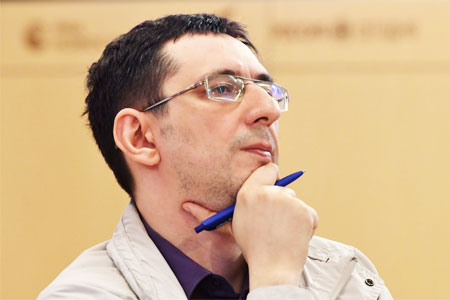
This opinion was shared by Andrey Areshev, political observer and expert at the Strategic Culture Foundation, during a Moscow-Yerevan video conference. He was commenting on the April meeting between the Armenian and Russian leaders in Moscow, as well as the subsequent statements by the Russian side.
Areshev recalled that the meeting between Pashinyan and Putin has caused quite a stir. However, in his opinion, nothing out of the ordinary was said at that meeting. "After all, it was clear that the Armenian leadership would continue to make use of the advantages provided by membership in the Eurasian Economic Union (EAEU), while also pursuing a European agenda, for domestic political reasons. As we know, much of what is happening in Armenia is currently driven by the logic of the election campaign, and tensions will only increase in the lead-up to June 7, 2026," the expert believes.
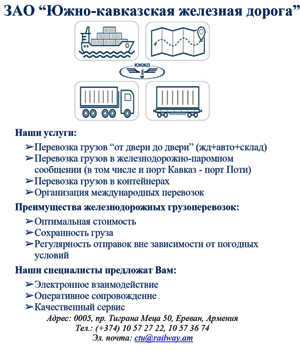
Areshev also stated that Pashinyan's government will continue to attempt to combine differnet vectors of foreign economic and foreign policy activities, including defense cooperation, which is no secret to Russia. He also noted that after April 1, subsequent contacts and discussions on current Armenian-Russian relations were guided by the following idea: "There's no need to smash pots; this will lead to nothing positive for either Russia or Armenia. Instead, we must strive to maintain pragmatic relations where it serves the interests of both states. At the same time, it's perfectly clear-Russian President Vladimir Putin and then Deputy Prime Minister Alexey Overchuk have already stated this-that simultaneous participation in two integration associations is impossible. But we already knew this. And in this sense, the controversial information campaign regarding a possible revision of the South Caucasus Railway concession agreement hasn't brought any positive results. The parties will most likely try to resolve this issue based on shared interests. And I think that, despite various statements, Russia will try to build a pragmatic dialogue with any Armenian government that will be formed following the June 7 elections," Areshev noted.
At the same time, the expert emphasized the importance for the Russian side of having a strong and stable government. "This will ensure at least minimal predictability and mutual trust in Russian-Armenian relations for the next five years, to the extent possible," the expert concluded.
Recall, Putin and Pashinyan held talks in Moscow on April 1. The meeting took place in a rather tense atmosphere, with the parties exchanging accusations. The Russian leader expressed hope that, regardless of the outcome of the upcoming parliamentary elections in Armenia, the commitment to strengthening bilateral relations would be maintained. The Russian president emphasized that, no matter what happens, Russia will always be guided by what is best for the Armenian people. Putin also stated that Russia is relaxed about the development of Armenia's relations with the EU, but that Yerevan will not be able to be in two customs unions at once, expressing hope that the EU and the EAEU will interact in the future. In this regard, he reminded the prime minister that "Russia sells gas to Armenia at a significantly lower price than the current price of this fuel in Europe." Later, Russian Deputy Prime Minister Alexei Overchuk stated that "Armenia is approaching a point where Armenian-Russian relations can be reconsidered." Following this, at a briefing with journalists during the eighth extraordinary congress of the ruling Civil Contract party, Armenian Parliament Speaker Alen Simonyan threatened to withdraw the country from the CSTO and the EAEU if Russia decides to raise gas prices for Armenia.











 Who and why is sacrificing RA National Security Service`s reputation? - expert
  Tehran creating security environment in which sustainable shipping in Strait of Hormuz difficult to imagine without its direct participation - expert
  Arrested Armenian oligarch on economy and new jobs
  NA Vice Speaker candidate believes his wife`s salary as director of HayPost is the lowest in the company`s history
 RF Permanent Representative: There is no CSTO-Armenia conflict
 Moscow: NATO seeking to "Pull" Armenia away from CSTO Allies
  Political analyst: Russia intends to determine which "Camp" Armenia will choose through a referendum
 Narek Karapetyan will give up his parliamentary salary in favor of charitable contributions.
 Armenian analyst: Developing relations with Europe and the U.S. must not jeopardize relations with regional powers
 Armenia and France discuss further development of strategic partnership and EU cooperation
  To overcome risks Armenia must reduce domestic escalation - expert
  Zatulin: Pashinyan was eager to get back to Russia because he actually lost the elections
 Human rights activist Ruben Melikyan dismissed from YSU
 Pashinyan removed from INNOPROM guest list
 Zakharova: Armenia`s pro-EU pivot poses economic security risks to EAEU member states
 It`s time for South Caucasus countries to think of South Caucasus as single, unified region - RA premier
  Pashinyan: Armenia and Azerbaijan should leave each other alone