
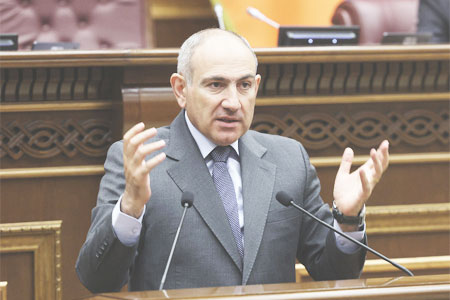
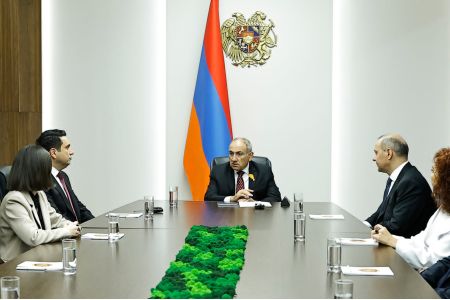
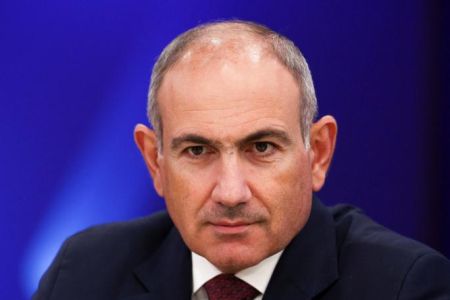
ArmInfo.Armenia highly values the activities of the Armenia-EU civil society platform, particularly in the context of the ruling political party's ideology and perception of democracy. This was stated by RA Prime Minister Nikol Pashinyan on April 15 at the opening ceremony of the 8th meeting of the platform.
According to him, in the current situation, it is difficult to underestimate the role of civil society in the lives of the Armenian people. At the same time, Pashinyan emphasized that today it is crucial to create mechanisms that would elevate the interaction between the government, civil society, and state and local authorities to a new, institutional level. This will allow for more coordinated and, consequently, more effective work.
The Prime Minister noted that despite achieving high economic and democratic development indicators since the velvet, non-violent revolution of 2018, the country still faces serious challenges, the solution of which is a priority for the authorities. In searching for solutions to these problems, it becomes clear that the country is confronted with seemingly invisible issues.
In particular, this involves clarifying key concepts. "Since the 2018 revolution, we have failed to achieve success in the justice sector that could be assessed as 'good' or 'satisfactory.' And there's truth to this: when we try to understand the situation, we are faced with the question of what exactly constitutes justice and the judiciary? Discussions have revealed that there is no unified approach on this issue. Disagreements arise even between representatives of different professional groups. For example, legal scholars consider justice one way, politicians another, and business entities and citizens present their own arguments. In general, when justice is administered, we are dealing with two parties, one of which wins, the other loses. This raises the question of how to ensure that both parties consider the process fair," the head of the Armenian government said.
Pashinyan added that, analyzing these two circumstances, he concluded that an organic connection between processes and institutions, the authorities, and their connection with the people is essential. In the current situation, Nikol Pashinyan continued, no one will have a sense of justice and fairness until this organic connection exists. This is the most important problem that must be addressed in the future with the adoption of a new Constitution of the Republic of Armenia.
The Prime Minister emphasized that currently, justice, fairness, and the judiciary are guided by institutions that are isolated, insular, lack an organic connection with the people, and, accordingly, lack the necessary level of accountability and responsibility. Meanwhile, the people are the ultimate authority in the formation of power. In this context, Nikol Pashinyan emphasized the need for criteria for assessing justice and fairness that must be consistent with the Constitution and laws of the country. "But what do you do when the Constitution itself is not organically linked to the main source of power? In that case, no matter what you do, there will be no justice or fairness, because the country's Basic Law must be a manifestation of the free will of the people, which is not the case today and has never been the case before. It is crucial for us to have mechanisms that meet European standards to correct any potential errors," the head of state emphasized.
He added that the Comprehensive and Enhanced Partnership Agreement between Armenia and the EU is a working agenda for the Armenian side, which has been expanded thanks to the expanded and unprecedented development of relations between Yerevan and Brussels in recent years. "We will confidently continue our path to the EU. We have already adopted a law on the start of the EU accession process, but this does not mean using blackmail against our European partners with demands for EU membership. Absolutely not. At this stage, it is crucial for us to continue our reform policy in a way that truly meets all European standards. Once we achieve this, the question of whether or not to be in the EU will be a matter of political decision," the RA Prime Minister concluded.






 Expert: Current process is not about peace, but implementing Azerbaijan`s wishlist
 Expert: Real peace unattainable until Armenia-Azerbaijan agreement is signed and ratified
 TRIPP`s proximity to Iranian border could slow its implementation - expert
  Who and why is sacrificing RA National Security Service`s reputation? - expert
  Tehran creating security environment in which sustainable shipping in Strait of Hormuz difficult to imagine without its direct participation - expert
  Arrested Armenian oligarch on economy and new jobs
  NA Vice Speaker candidate believes his wife`s salary as director of HayPost is the lowest in the company`s history
 RF Permanent Representative: There is no CSTO-Armenia conflict
 Moscow: NATO seeking to "Pull" Armenia away from CSTO Allies
  Political analyst: Russia intends to determine which "Camp" Armenia will choose through a referendum
 Narek Karapetyan will give up his parliamentary salary in favor of charitable contributions.
 Armenian analyst: Developing relations with Europe and the U.S. must not jeopardize relations with regional powers
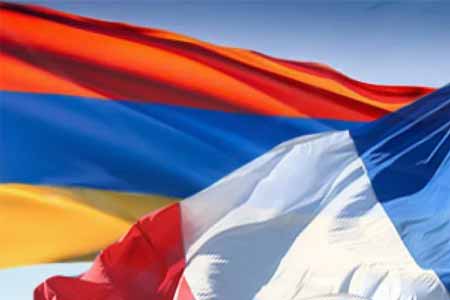 Armenia and France discuss further development of strategic partnership and EU cooperation
 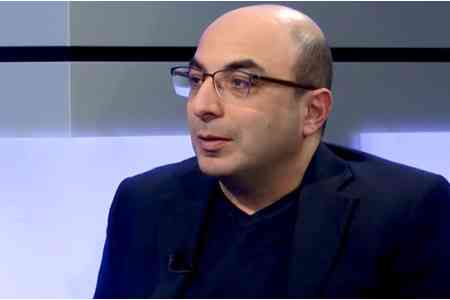 To overcome risks Armenia must reduce domestic escalation - expert
 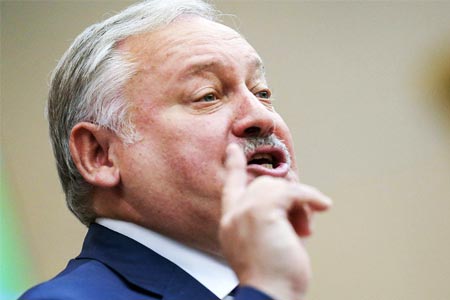 Zatulin: Pashinyan was eager to get back to Russia because he actually lost the elections
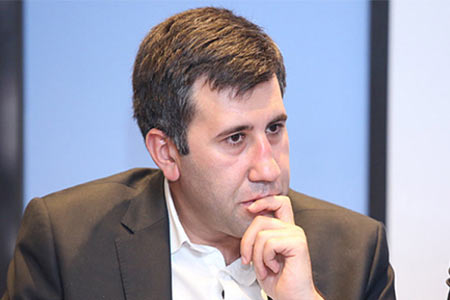 Human rights activist Ruben Melikyan dismissed from YSU
 Pashinyan removed from INNOPROM guest list
 Zakharova: Armenia`s pro-EU pivot poses economic security risks to EAEU member states
 It`s time for South Caucasus countries to think of South Caucasus as single, unified region - RA premier
  Pashinyan: Armenia and Azerbaijan should leave each other alone