

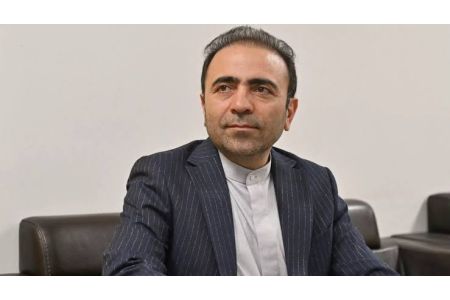
ArmInfo. If a situation arises in which Armenia’s national sovereignty or territorial integrity is under threat, Iran will express a resolute and very serious position. Iran’s Ambassador Extraordinary and Plenipotentiary to Armenia Khalil Shirgholami stated this at a conference on TRIPP on September 17.
The diplomat noted that Iran had resolutely and clearly opposed the idea of the so-called "Zangezur corridor," as this program was aimed at reducing Armenia’s sovereignty.
He once again emphasized that, within the framework of any alternative project, preserving Armenia’s national sovereignty and territorial integrity is a "red line" for Iran?
"If a situation arises in which Armenia’s national sovereignty or territorial integrity is under threat, Iran will express a resolute and very serious position," the ambassador noted.
At the same time, he expressed the conviction that it was precisely the historical sense of geopolitical isolation and constriction that played a more important role than economic considerations and prompted Armenia to join the project linking Nakhijevan with Azerbaijan.
At the same time, the diplomat believes that only time will show how the TRIPP project can help Armenia emerge from isolation and rid itself of the feeling of isolation.
"The second issue that needs to be considered is ensuring Armenia’s national sovereignty and the position that guarantees for this sovereignty must be provided, especially under conditions of external pressure, in particular, in the context of the project promoted and speculatively used by Azerbaijan under the name of the "Zangezur corridor," as well as under conditions of external pressure around Armenia, particularly in light of the demands that some of Armenia’s neighbors have made of it. This project contains elements unacceptable from the standpoint of sovereignty, which created threats to Armenia’s national sovereignty, and it seems that Armenia brought in the United States as a balancing factor and an additional guarantee to ensure security and sovereignty, as well as to ease the pressure from Ankara and Baku," the ambassador of the Islamic Republic of Iran believes.
At the same time, he is confident that only time will show to what extent, within the framework of TRIPP, certain parties are attempting to implement precisely the objectives envisaged by the "Zangezur corridor," and to what extent Armenia will manage to preserve its national sovereignty and guarantee its protection, as well as how committed the current and future U.S. authorities will be to implementing the project and how much they will attempt to support the protection of Armenia’s national sovereignty and territorial integrity.
Shirgholami then pointed to the importance of clear mechanisms for implementing the project that would contribute to strengthening Armenia’s national sovereignty and territorial integrity, and suggested that even the Armenian authorities do not have a comprehensive understanding of this issue.
Touching upon Tehran’s position on the project, he stated that, given the hostile attitude of the United States toward the Iranian people, the Iranian side had serious concerns about the presence of Americans on the border between Armenia and Iran. However, according to him, if, in implementing TRIPP, the United States proceeds from the need to minimally hinder the development of relations between Armenia and Iran, this will also be a very important achievement. In his words, the best way to dispel Iran’s concerns here is to have an institutional mechanism through which emerging issues could be discussed and managed.
"We hope that the Armenian Government will adhere to such an approach on this important issue that Armenia’s national sovereignty and territorial integrity will not suffer, that the country will be able to consistently advance its economic interests, and that relations between Armenia and its neighbors will not be harmed," Shirgholami emphasized.
At the same time, the ambassador of the Islamic Republic of Iran emphasized that just as Armenia is responsibly attempting, within the framework of TRIPP, to help Azerbaijan establish a land connection with Nakhijevan and is investing efforts in building peace, Azerbaijan must responsibly ensure the possibility of a railway connection between Armenia and Iran via Nakhijevan.
He expressed the supposition that establishing a railway connection between Yeraskh and Julfa could create new potential for Armenia, turning it into an important hub linking the Persian Gulf and the Black Sea.























 Armenian Historian: People Like Magdalena Grono Should Be Kept Away from the Thresholds of Armenian Shrines
 Azerbaijani studies expert: Armenia’s Foreign Ministry could use the ICC against Aliyev’s Armenophobic statements
 An Armenian political analyst exposed Hajiyev’s lies and attempts to mislead diplomats accredited in Azerbaijan in occupied Artsakh
 Expert: The circus surrounding the “Albanization” of Armenian culture in the presence of foreign ambassadors in occupied Artsakh is genocide
 Zakharova: Russia ready to discuss with Armenia the prospects for expanding military cooperation as part of a review of bilateral ties
 Tevanyan: Armenia, like Ukraine and Moldova, is being drawn into the EU’s global war
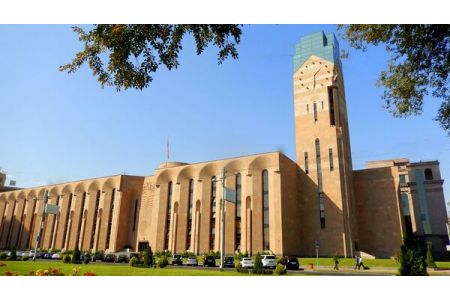 Yerevan City Hall is considering introducing a valet parking system in the city
 Political scientist: If Russian-Armenian relations are destroyed, Turkey will take Russia`s place
 Political scientist: The Armenian public is simply obliged to significantly change the entire content of public discourse and struggle
 Cross tattoos are being removed from the skin of Christian prisoners in Azerbaijan by fire, according to a human rights activist.
 Zakharova: Armenia`s likely introduction of visas with Russia will be a step against Yerevan itself
 Putin: Armenia`s recognition of Karabakh as part of Azerbaijan in Prague has given Russia`s position on this issue an ambivalent character
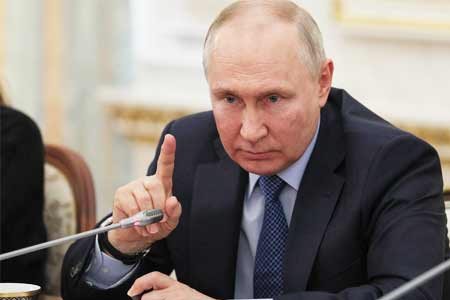 Putin: Armenia`s adoption of the law on EU accession means an announcement of its withdrawal from the Eurasian Economic Union
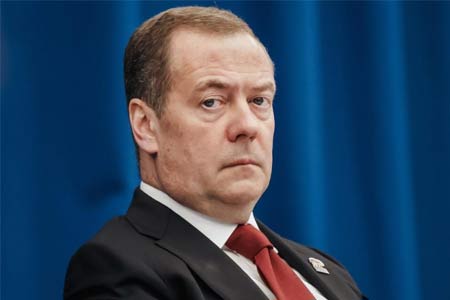 Medvedev: Yerevan will never become an EU member, but it will permanently damage relations with the Eurasian Economic Union, including with Moscow.
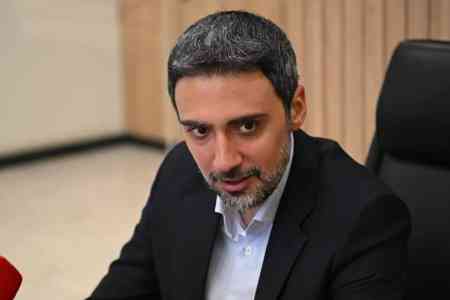 Aram Vardevanyan: Public demands solutions, not apology scandals in Parliament
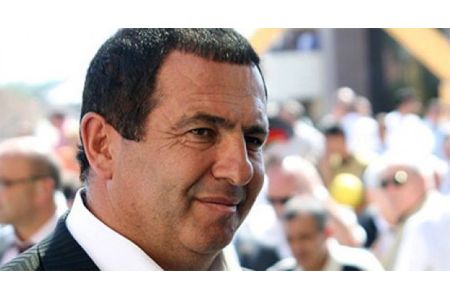 Arrested Armenian oligarch on economy and new jobs
  "In Baku, we gave a worthy rebuff to the false claims regarding the past and present of our people" – Former Artsakh Parliament Speaker from Baku captivity
  NA Vice Speaker candidate believes his wife`s salary as director of HayPost is the lowest in the company`s history