
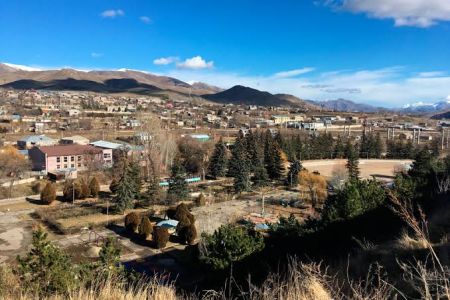
ArmInfo. There are areas in the administrative territory of the Kapan community that have come under Azerbaijani control, and the demarcation of the Armenian-Azerbaijani border could have begun from this area. This was stated by Deputy Head of the community, Gor Tadevosyan, in a conversation with journalists in Kapan, who visited the community to learn about the social and humanitarian programs implemented by the International Committee of the Red Cross in its border communities.
The official recalled that the community currently has occupied territories in the villages of Nerkin-Khand and Davit-Bek, while several other villages have become border villages.
"Today, we effectively have occupied territories under the administrative control of the Kapan community, specifically in the districts of Nerkin-Khand and Davit-Bek." "It is common knowledge that the Armenian cemetery in Nerkin-Khand is currently under the control of Azerbaijani military personnel," recalled Deputy Head of the Kapan community.
At the same time, Tadevosyan acknowledged that the territories should be returned to the community, as stated, as part of the process of demarcating the Armenian-Azerbaijani border, and acknowledged that this issue is not within the community's jurisdiction. However, he advocated for delimitation and demarcation to begin from this area.
"For example, demarcation could have begun precisely in this direction," Tadevosyan continued, recalling that the territories were lost as a result of events that occurred after the 44-day war of 2020 in the Nagorno-Karabakh conflict zone.
He also acknowledged that after the loss of these territories and the reduction of arable land and pastures, the population of these villages received no compensation from the state, even though these losses directly impacted their income.
In this vein, he reported that the community leadership attempted to mitigate the consequences of land loss by seeking various support programs. For example, he noted that the International Committee of the Red Cross implemented social and humanitarian projects in 15 settlements of the community, which helped prevent the outflow of the border population. According to him, ICRC programs provided the population with crucial support at that time.
"In the post-war period, a number of important projects were implemented in the border areas, particularly those related to overcoming the winter. Furthermore, following the loss of arable land, programs to reclaim degraded lands and provide elite grain seeds were implemented with the assistance of the ICRC," Tadevosyan said.
The official added that over the past five to six years, significant work has been done to prevent the outflow of population from the border areas amid the changing situation on the country's borders after the war. "Thanks to these efforts, we managed to prevent a mass exodus from Kapan and border settlements. I can say that we have no outflow of population," the official concluded.























 Expert: The defeated authorities` position on normalizing relations with the enemy should not affect the rights of Artsakh refugees
 Expert: Fourth Republic is not to begin with Kocharyan`s arrest
 Expert: Armenia continues to `peel away` from Russian-led military-political and economic structures
 Zakharova: Armenia`s likely introduction of visas with Russia will be a step against Yerevan itself
 Putin: Armenia`s recognition of Karabakh as part of Azerbaijan in Prague has given Russia`s position on this issue an ambivalent character
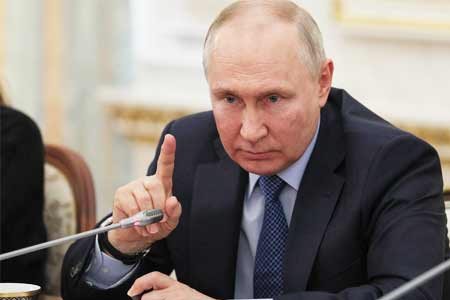 Putin: Armenia`s adoption of the law on EU accession means an announcement of its withdrawal from the Eurasian Economic Union
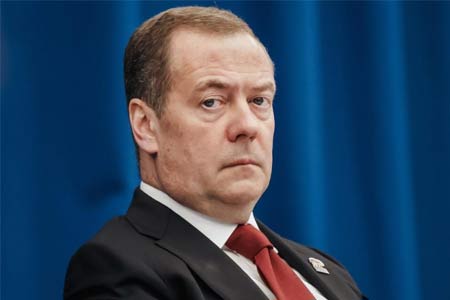 Medvedev: Yerevan will never become an EU member, but it will permanently damage relations with the Eurasian Economic Union, including with Moscow.
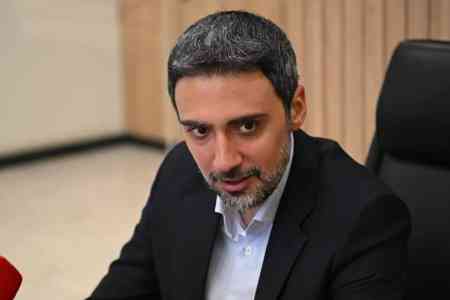 Aram Vardevanyan: Public demands solutions, not apology scandals in Parliament
 Arrested Armenian oligarch on economy and new jobs
  "In Baku, we gave a worthy rebuff to the false claims regarding the past and present of our people" – Former Artsakh Parliament Speaker from Baku captivity
  NA Vice Speaker candidate believes his wife`s salary as director of HayPost is the lowest in the company`s history
 RF Permanent Representative: There is no CSTO-Armenia conflict
 Moscow: NATO seeking to "Pull" Armenia away from CSTO Allies
  Political analyst: Russia intends to determine which "Camp" Armenia will choose through a referendum
 Narek Karapetyan will give up his parliamentary salary in favor of charitable contributions.
 Armenia and France discuss further development of strategic partnership and EU cooperation